OPINION: Who Controls the Field? When TPAction Enters Local Party Operations
By Scott Finley, October 17, 2026 6:00 am
What happens when an employee of an outside political organization simultaneously holds a key operational position inside a county political party? In March 2025, I received an email from Kit Di Carlo, now Kit Waite, in which she identified herself at the same time as Turning Point Action’s Field Representative for Northern Nevada and the newly appointed Field Operations Chair for the Washoe County Republican Party. That overlap does not, by itself, establish wrongdoing. But it raises important questions about organizational independence, conflicts of interest, compensation, voter data, and who ultimately controls the machinery of local party operations. Those are among the issues I have sought to clarify through records requests and a review of the available evidence.
My interest in these questions is not abstract. I became a member of the Washoe County Republican Central Committee in 2024 and had firsthand exposure to its meetings, committees, field operations, and internal processes. As questions began to emerge about the relationship between outside political organizations and the county party’s own operations, I became increasingly interested in how authority, personnel, data, and accountability were being managed.
Why Field Operations Matters
Field operations can be one of the most influential operational functions within a political organization. It often involves coordinating volunteers, precinct-level activity, voter outreach, information, resources, and the implementation of broader organizational strategy. Because of those responsibilities, field operations can function as a practical gatekeeping mechanism by influencing who participates, what information reaches participants, how resources are distributed, and how strategic objectives are carried out.
That does not mean field operations holds ultimate authority within an organization. Formal decision-making may rest with elected officers, an executive committee, or the central committee itself. But the person directing field operations can still exercise substantial practical influence over the organization’s day-to-day political activity. For that reason, questions involving independence, conflicts of interest, outside employment, access to voter data, and control of operational resources deserve careful scrutiny.
The TPAction–WCRCC Overlap
I first met Schayden Gorai in 2023, when he told me he was Turning Point Action’s salaried field representative for Northern Nevada. Following the 2024 election cycle, Schayden relocated to Southern Nevada.
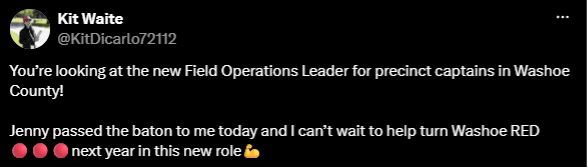
By March 2025, Kit was publicly describing a new field-operations role in Washoe County. On March 16, 2025, Kit announced on X that she was the new “Field Operations Leader for precinct captains in Washoe County” and wrote that the former Field Operations Chair for the Washoe GOP had “passed the baton” to her.
Ten days later, on March 26, 2025, the overlap between Kit’s Turning Point Action role and her Washoe County Republican Party role was made explicit in a communication she sent from the WCRCC Field Operations account to me and other recipients. In the opening paragraph, she identified herself simultaneously as “the Turning Point Action Field Representative for Northern Nevada” and as having “been appointed as the new Field Operations Chair for the Washoe GOP.”
March 26, 2025 WCRCC Field Operations email
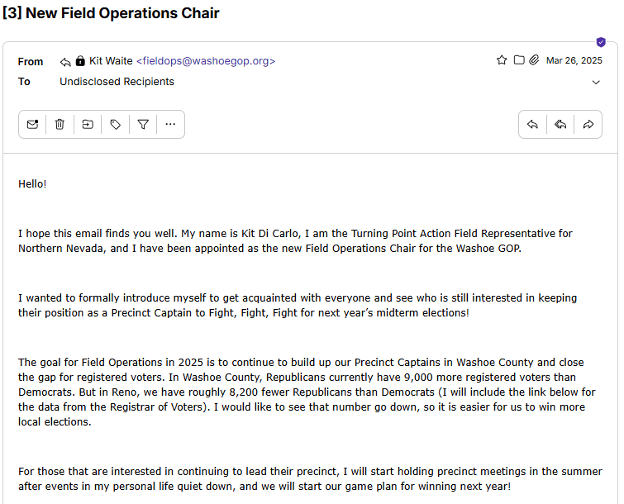
The remainder of the email concerned her Washoe GOP responsibilities. She contacted precinct captains about whether they intended to continue serving, discussed Republican and Democratic voter-registration numbers, described a 2025 goal of building the party’s precinct-captain operation and narrowing voter-registration gaps, and said she planned to begin holding precinct meetings in preparation for the 2026 midterm elections.
That contemporaneous email is significant to my inquiry because it does not require speculation about whether the two roles overlapped. Kit herself identified both positions in the same communication while using the WCRCC Field Operations account to conduct county-party business. What the email does not answer is how the two roles were separated in practice: whether Washoe GOP work occurred during compensated TPAction time, whether TPAction resources were used, whether any services were reimbursed or valued, what data each organization could access, or whether formal conflict-of-interest or outside-activity safeguards existed. Those are among the issues I have sought to clarify through records requests.
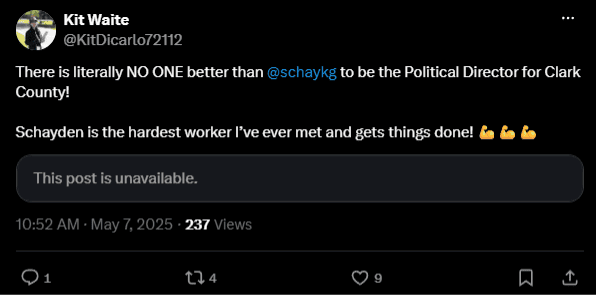
On May 7, 2025, Kit publicly supported Schayden for a political-director position with the Clark County Republican Party, describing him on X as exceptionally hardworking and effective. Schayden later withdrew from consideration.
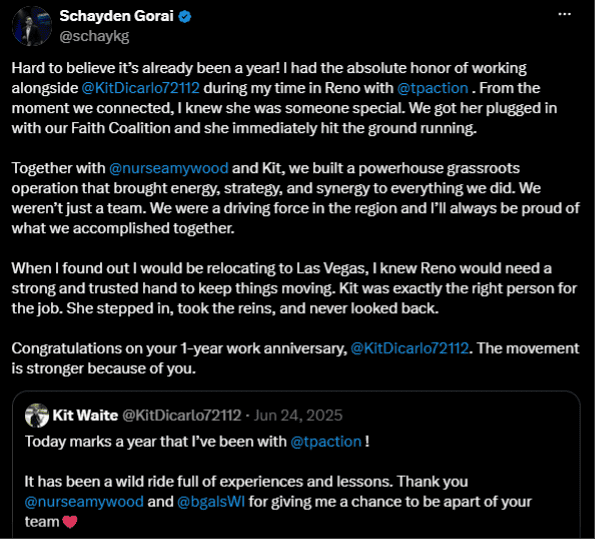
Schayden’s own subsequent public comments provide additional context for the Northern Nevada transition. In a June 25, 2025 X post discussing his time in Reno with Turning Point Action, Schayden wrote that when he learned he would be relocating to Las Vegas, he believed Reno needed “a strong and trusted hand to keep things moving.” Referring to Kit, he wrote that she “stepped in, took the reins, and never looked back.” His post also congratulated her on her one-year anniversary with Turning Point Action.
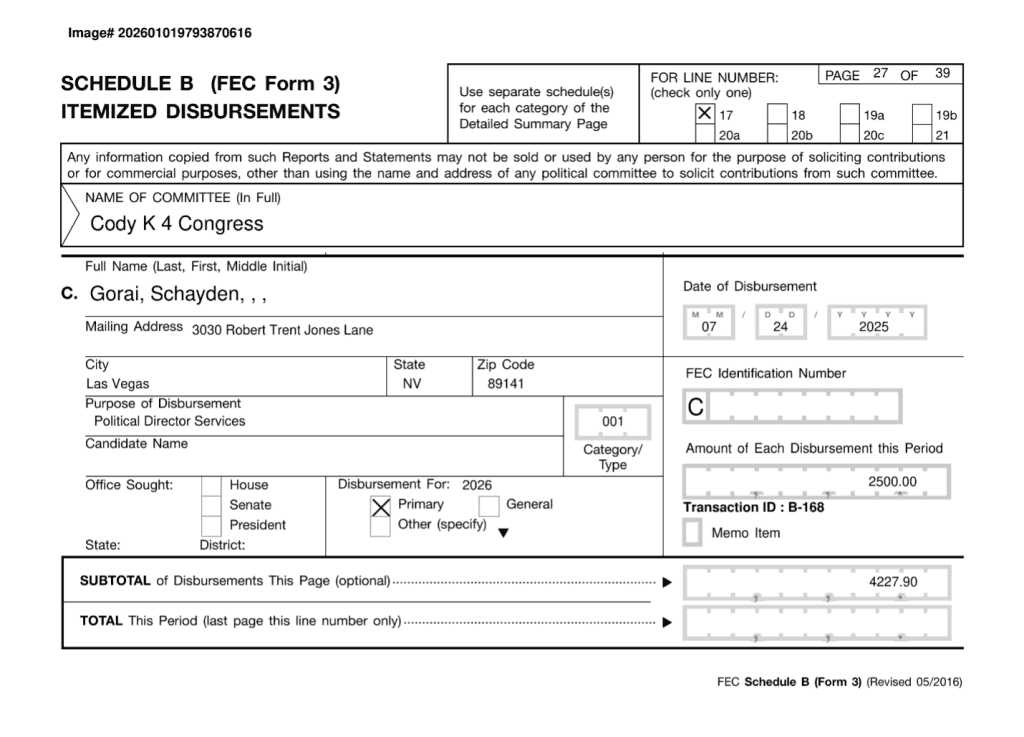
Federal campaign-finance records subsequently show Cody K 4 Congress paying Schayden for “Political Director Services,” beginning in July 24, 2025.
Questions I Raised
None of these facts, standing alone, establishes unlawful conduct. They do, however, present legitimate questions about organizational independence, conflicts of interest, compensation, access to political data and technology, and the safeguards used when an employee of an outside political organization simultaneously occupies an operational position within a county political party. Those are factual questions that records should answer.
My concerns began well before I started requesting records. When I first learned of Kit’s appointment, I was caught off guard and raised the issue privately with several people involved in or familiar with the WCRCC. My concerns were quickly dismissed. During one of those conversations, one member responded, as I recall it, “But TPAction is on our side!”
That response stayed with me because it did not address the substance of the concern I was raising. My question was not whether Turning Point Action was politically aligned with the Republican Party. My concern was whether an employee of an outside political organization should simultaneously hold an influential operational position within a county political party, and what safeguards existed to keep those roles institutionally separate.
CampaignSidekick/Pulsar
At the January 2026 WCRCC meeting, members were informed that a new Field Operations Chair would be replacing Kit. During that same meeting, the WCRCC chair raised the subject of CampaignSidekick, the voter-contact and field application the party had previously used. As I recall the discussion, he acknowledged that the system had performed poorly and explained that the Nevada Republican Party was under contract to use it.
The chair further told the Central Committee that data within CampaignSidekick/Pulsar had not been properly maintained or updated and that the Nevada Republican Party had threatened legal action if the problems were not corrected or the party was not released from its contractual obligations. According to his account, the system subsequently improved substantially and was then working much better.
The timing caught my attention. The reported improvement in CampaignSidekick/Pulsar was discussed at the same meeting in which WCRCC members learned that Kit would no longer serve as Field Operations Chair. That timing does not establish that the two developments were connected, and I do not claim that it does. It did, however, raise additional questions for me about how voter and field data had been managed during the preceding year, what systems were being used by WCRCC, Nevada GOP, and Turning Point Action, whether information moved between those systems, and what technical changes occurred before CampaignSidekick/Pulsar reportedly began functioning more effectively.
Those questions are among the reasons I have sought records from WCRCC, Nevada GOP, Turning Point Action, CampaignSidekick/Pulsar, and the Washoe County Registrar of Voters. My objective is to determine what the underlying records show about system access, data transfers, account administration, contractual relationships, technical changes, and the separation, or overlap, between the organizations involved.
A Credentialing Problem of My Own
My concerns about internal safeguards were later reinforced by my own experience with WCRCC credentialing. The WCRCC bylaws in effect at the time stated that a member of the Central Committee “must be a registered Republican voter in Washoe County, Nevada.” The bylaws also required verification of Republican registration when filling Central Committee vacancies by nomination. (WCRCC Bylaws, as amended February 24, 2026, Article III, Sections 3(C) and 4(A)).
In August 2026, I changed my voter registration from Republican to nonpartisan. When I attended the September 2026 WCRCC meeting, however, I was checked in as usual and received the precinct badge used to identify credentialed voting members.
That meeting included elections for representatives to the State Central Committee. I was provided a ballot and therefore appeared to retain the ability to participate in the election despite no longer satisfying the Republican-registration requirement contained in the WCRCC bylaws. Rather than cast a vote that I did not believe I should exercise, I wrote “VOID” on ballot number 76 and placed it in the ballot box.
My experience does not establish how many other members, if any, were improperly credentialed. It does raise a straightforward procedural question: how frequently does the WCRCC verify that credentialed voting members continue to satisfy its membership requirements, particularly before internal elections? The experience also reminded me that concerns about election integrity are not limited to public elections; internal party elections depend on accurate credentialing and consistent enforcement of membership rules as well.
What the Law May Require
If Turning Point Action was compensating Kit while she performed substantive WCRCC work for which money otherwise would have been paid, Nevada campaign-finance law may be relevant. NRS 294A.007 can, under specified circumstances, treat compensated personnel time and certain services provided without charge as contributions, while NAC 294A.043 requires qualifying in-kind goods or services to be valued for applicable campaign-finance reporting.
That is why records concerning time allocation, compensation, reimbursement, fair-market value, in-kind contribution statements, and separation of duties matter. A salaried TPAction employee simultaneously holding a WCRCC position is not, by itself, evidence of unlawful conduct. The key questions are what work was performed, when it was performed, who paid for it, whether it constituted a contribution, and whether any required reporting occurred. Applicable Chapter 294A violations can carry penalties of up to $10,000 per violation.
Voter-file handling raises separate questions. NRS 293.440 restricts certain uses of voter lists, including use for purposes unrelated to an election and sale for compensation or other valuable consideration. Merely transferring voter information into CampaignSidekick/Pulsar or the TPAction application for legitimate election activity would not, by itself, establish a violation. Prohibited non-election use or a sale for valuable consideration would present a different legal issue.
Chapter 293 violations can carry civil penalties of up to $20,000 per violation, while certain election-law offenses may also carry criminal consequences. Whether any particular transfer, use, report, or omission constitutes a violation, and whether it represents one violation or several, depends on the specific facts and applicable law.
Federal campaign-finance law presents another, separate inquiry and generally requires a federal-election nexus. A dual-role arrangement or purely State or local political activity does not automatically create a federal violation. Records showing how personnel, voter data, and other resources were actually used would be necessary to determine whether federal requirements were implicated.
None of these potential penalties establishes that any person or organization committed an offense. That determination depends on the facts the records requests are intended to clarify.
Where Do We Go From Here?
The answer should begin with transparency. The questions raised by these events should not be resolved through rumors, assumptions, political loyalties, or assurances that everything was handled properly. They should be answered by the underlying records.
If the records show that appropriate safeguards existed, that duties were properly separated, that voter data was handled lawfully, and that any required campaign-finance reporting occurred, then those facts should be made clear. If the records reveal deficiencies, those deficiencies should be acknowledged and corrected.
Political organizations depend on the confidence of the people who participate in them. That confidence is strengthened when appointments, conflicts of interest, access to voter information, financial relationships, and operational responsibilities can withstand scrutiny.
My purpose in pursuing these questions is not to presume wrongdoing. It is to determine what happened, what safeguards were in place, and whether those safeguards were adequate. The public record should be allowed to answer those questions.
Speak Up, Nevada! What’s on Your Mind? Send us your opinion!
Got the inside scoop on something happening in Nevada? Or the country? Do you have thoughts about life in Nevada that are too good to keep to yourself? Whether it’s a hot take on our politics, crime, education, or even the secret to surviving our summers, we’re all ears! Swing them our way at editor@thenevadaglobe.com. Come on, give us the scoop on what makes Nevada tick—or what ticks you off. Let’s make some noise and have some fun with it!
*************************
Legal Disclaimer
The opinions expressed in this article, authored by Scott Finley, are solely those of the author and do not reflect the views or positions of Nevada Globe. This content is provided for informational purposes only and has not been endorsed by Nevada Globe. We make no representations or warranties of any kind, express or implied, about the completeness, accuracy, reliability, suitability, or availability with respect to the content contained on this site for any purpose. Any reliance you place on such information is therefore strictly at your own risk.
Nevada Globe is not responsible for, and expressly disclaims all liability for, damages of any kind arising out of use, reference to, or reliance on any information contained within the article. No guarantee is given that the information provided in this article is correct, complete, or up-to-date.
Although this article may include links providing direct access to other Internet resources, including websites, Nevada Globe is not responsible for the accuracy or content of information contained in these sites.
Links from Nevada Globe to third-party sites do not constitute an endorsement by Nevada Globe of the parties or their products and services. The appearance on the website of advertisements and product or service information does not constitute an endorsement by Nevada Globe, and Nevada Globe has not investigated the claims made by any advertiser.


- OPINION: Who Controls the Field? When TPAction Enters Local Party Operations - October 17, 2026
- OPINION: Standardizing Greed: The Real Agenda Behind SB 495 - June 3, 2025
- OPINION: A Travesty Against Innocence in Washoe County - February 4, 2025
RELATED ARTICLES
-

-
December 26, 2024
-
November 9, 2022