PARENTS CALL THE SHOTS: Trump Overhauls Childhood Vaccine Guidance, Puts Nevada Mandates Under Spotlight
By TheNevadaGlobeStaff, August 11, 2026 6:00 am
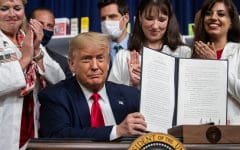
President Donald Trump signed an executive order Monday launching a sweeping overhaul of federal childhood vaccine guidance, replacing a one-size-fits-all approach with three categories of recommendations and placing parental authority at the center of the nation’s immunization policy.
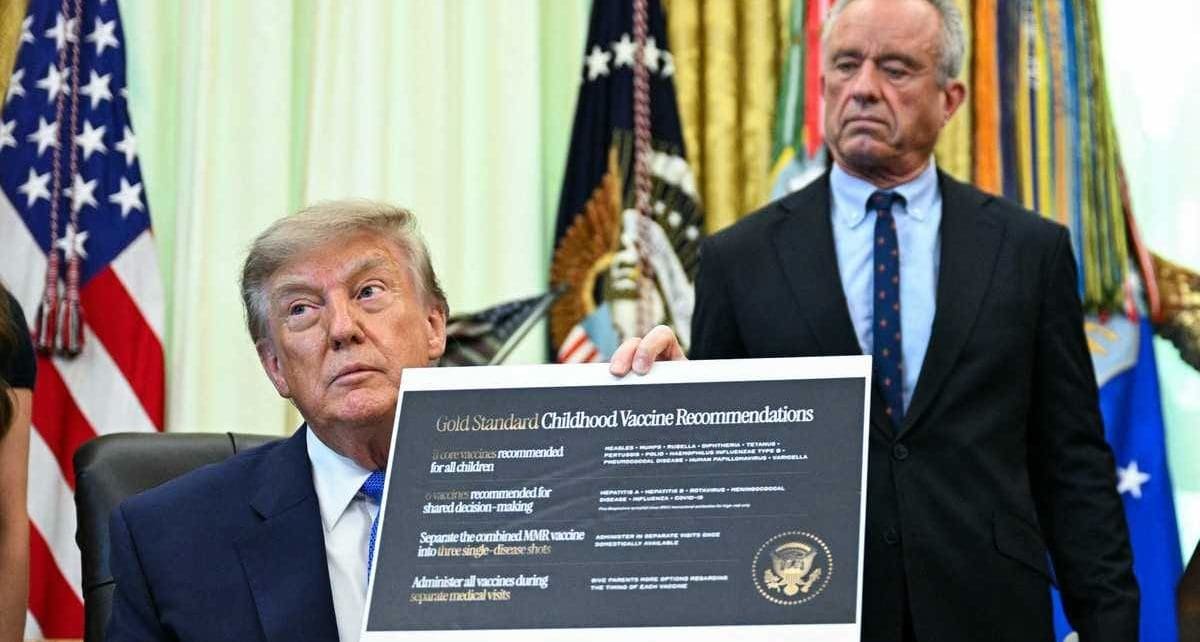
The order recognizes what the administration calls the “Gold Standard Childhood Vaccine Recommendations,” directs federal agencies to advance the new framework and urges states, including Nevada, to review school vaccination requirements against the updated guidance.
It does not ban vaccines, eliminate access or immediately erase any state mandate.
Instead, Trump’s order narrows the list of immunizations recommended for every child, moves others into risk-based or parent-and-doctor decision-making categories and instructs the federal government to expand safety research, transparency and vaccine options.
“It is the policy of my Administration that Federal programs and funding should support maximal parental choice over childhood vaccines,” the order states.
Under the new framework, the federal government recommends that all children receive immunizations protecting against 11 diseases: measles, mumps, rubella, diphtheria, tetanus, pertussis, polio, Haemophilus influenzae type B, pneumococcal disease, human papillomavirus and varicella.
The White House says that represents a decrease from the 18 diseases included in the Centers for Disease Control and Prevention’s 2024 routine childhood recommendations.
Several other immunizations would remain available but would no longer be universally recommended.
Respiratory syncytial virus monoclonal antibodies and vaccines for hepatitis A, hepatitis B, meningococcal disease and dengue are placed in a category for certain high-risk groups or populations. Hepatitis A, hepatitis B, rotavirus, meningococcal disease, influenza and COVID-19 are also included in the shared clinical decision-making category, depending upon a child’s age, health and individual risk.
That overlap reflects the administration’s central argument: Some vaccines may be appropriate for a high-risk population without being treated as a blanket recommendation for every child in every circumstance.
The final decision would rest more heavily with parents and clinicians.
According to the White House fact sheet, the new approach was built from a Department of Health and Human Services assessment comparing America’s childhood vaccine schedule with those of other developed countries.
The administration says the United States recommends more childhood vaccine doses than any peer nation, including more than twice as many doses as some European countries.
The HHS assessment also concluded that many peer nations maintain high vaccination rates through public trust and education instead of school mandates.
The United States takes a different approach. States, not Washington, generally establish the vaccines children must receive before entering a classroom.
Trump’s executive order advises states and territories to review those laws and consider bringing them into line with the new federal recommendations.
That puts Nevada directly in the conversation.
Nevada currently requires children entering kindergarten or enrolling in a new school district to show proof of vaccination against diphtheria, tetanus, pertussis, polio, rubella, measles, mumps, hepatitis A, hepatitis B and varicella, unless they qualify for an exemption.
The federal order creates a clear point of tension: Nevada requires hepatitis A and hepatitis B immunization for school enrollment, while Trump’s framework moves those vaccines out of the universal category and into risk-based or shared decision-making categories.
At the same time, the new federal framework universally recommends protection against HPV, Hib and pneumococcal disease, none of which appears on Nevada’s basic kindergarten school-entry list.
In other words, adopting the Trump framework would not be as simple as taking a red pen to Nevada’s existing rules. State lawmakers and health regulators would have to decide which requirements belong at the schoolhouse door and which decisions should remain inside the doctor’s office.
Nothing changes in Nevada classrooms overnight.
The executive order does not override state law, and Nevada’s existing requirements remain in force unless state officials amend the relevant statutes or regulations.
Nevada already recognizes two of the protections emphasized by Trump.
Under Nevada law, public schools must honor a religious exemption when a parent or guardian submits a written statement that the family’s religious beliefs prohibit immunization. A separate medical exemption is available when a physician or advanced practice registered nurse determines that a child’s medical condition prevents full or partial vaccination.
Those exemptions are not absolute during an outbreak. State law permits school officials to require an exempt child to be immunized or remain away from school when health authorities determine that a dangerous contagious disease is present.
Trump’s order directs the Departments of Justice, Education and HHS to ensure that federal contractors and grant recipients comply with constitutional and federal protections involving parental authority, religious liberty, disability accommodations and equal protection.
It also directs the attorney general to support meritorious legal challenges against state laws that violate those protections.
Because Nevada already provides religious and medical exemptions, the most immediate state-level fight is more likely to center on the scope of required vaccines than the existence of exemptions themselves.
The debate carries real consequences for Nevada families and schools.
State health data show that 89.7 percent of Nevada kindergarten students were vaccinated during the 2025–2026 school year. Religious exemptions reached 7.3 percent statewide, while medical exemptions accounted for 0.2 percent.
The geographic divide was notable. Washoe County schools reported a kindergarten vaccination rate of 93.7 percent, compared with 88.9 percent in Clark County, according to a Nevada Division of Public and Behavioral Health presentation.
Those numbers ensure any proposed change will draw fierce arguments from parents, physicians, public-health officials and lawmakers.
The most visible dispute may center on how vaccines are administered.
Trump’s order recommends separating the combined measles, mumps and rubella vaccine into three single-disease shots once those products become domestically available. It also says childhood immunizations should be given at separate medical visits “to the maximum extent feasible.”
The administration argues that separating the shots will give parents greater control over timing and frequency. The order directs HHS to preserve the continued availability of combination vaccines, meaning parents who prefer the combined MMR shot would retain that option under the administration’s plan.
The American Academy of Pediatrics takes a sharply different view of the underlying medical debate. The organization says research has found that receiving multiple or combination vaccines does not overwhelm a child’s immune system.
The CDC has also argued that combination vaccines mean fewer injections, fewer medical visits, less cost and a greater likelihood that children receive protection on time.
That leaves a practical question alongside the scientific and political ones.
More appointments can mean more control, but they can also mean more time away from work, additional travel and scheduling costs and more opportunities for a child to miss a dose. How HHS handles that tradeoff will determine whether the policy expands meaningful choice or merely rearranges the calendar.
The next phase begins immediately.
Trump ordered the HHS Task Force on Safer Childhood Vaccines to present a plan within 90 days for expanding single-vaccine options, beginning with MMR; reassessing the timing and sequence of the childhood schedule; developing alternatives to aluminum-based adjuvants; conducting comparative safety and efficacy studies; continuously evaluating risk-benefit profiles; and strengthening safety monitoring and transparency.
The order arrives after earlier administration efforts to revise the schedule became entangled in litigation over the composition of the Advisory Committee on Immunization Practices and separate federal vaccine updates.
Trump is now attempting to move the policy forward directly from the White House.
Supporters will see a long-overdue correction after the COVID era, when public-health agencies burned through trust by treating legitimate parental questions as obstacles to be managed. Critics will see a retreat from a schedule they credit with preventing outbreaks and saving lives.
Both sides will now bring that argument to Carson City.
The order does not force Nevada to repeal a single requirement. It does force state leaders to answer a question many parents have been asking for years: Which childhood vaccines should government require, and which decisions properly belong to families and their doctors?
For decades, parents were often handed a schedule and told the debate was over.
Trump just reopened it and made clear that this time, parents will have a seat at the table.
Speak Up, Nevada! What’s on Your Mind? Send us your opinion!
Got the inside scoop on something happening in Nevada? Or the country? Do you have thoughts about life in Nevada that are too good to keep to yourself? Whether it’s a hot take on our politics, crime, education, or even the secret to surviving our summers, we’re all ears! Swing them our way at editor@thenevadaglobe.com. Come on, give us the scoop on what makes Nevada tick—or what ticks you off. Let’s make some noise and have some fun with it!


- NWS Flood Watch Takes Effect Across Las Vegas Valley as Remnants of Tropical Storm Rachel Menace Mojave Basin - October 10, 2026
- “Operation Loaded Dice”: Federal and Local Task Forces Net 144 Arrests in Expansive Southern Nevada Gang and Narcotics Crackdown - October 10, 2026
- PAYDAY AT THE PUMP: Buck Unleashes $300K-Plus Ad Blitz Hammering Titus on Gas Taxes - October 10, 2026
RELATED ARTICLES
-

-
July 27, 2025
-
September 4, 2025