MINE, BABY, MINE: Trump Unleashes Billions to Rebuild American Mining as Nevada Stands to Lead
By TheNevadaGlobeStaff, August 10, 2026 6:00 am
WASHINGTON, D.C.: President Donald Trump announced more than $2 billion in new mining and mineral-processing investments Friday, launching a sweeping effort to rebuild America’s industrial base, secure military supply chains and end the country’s dangerous dependence on Communist China.
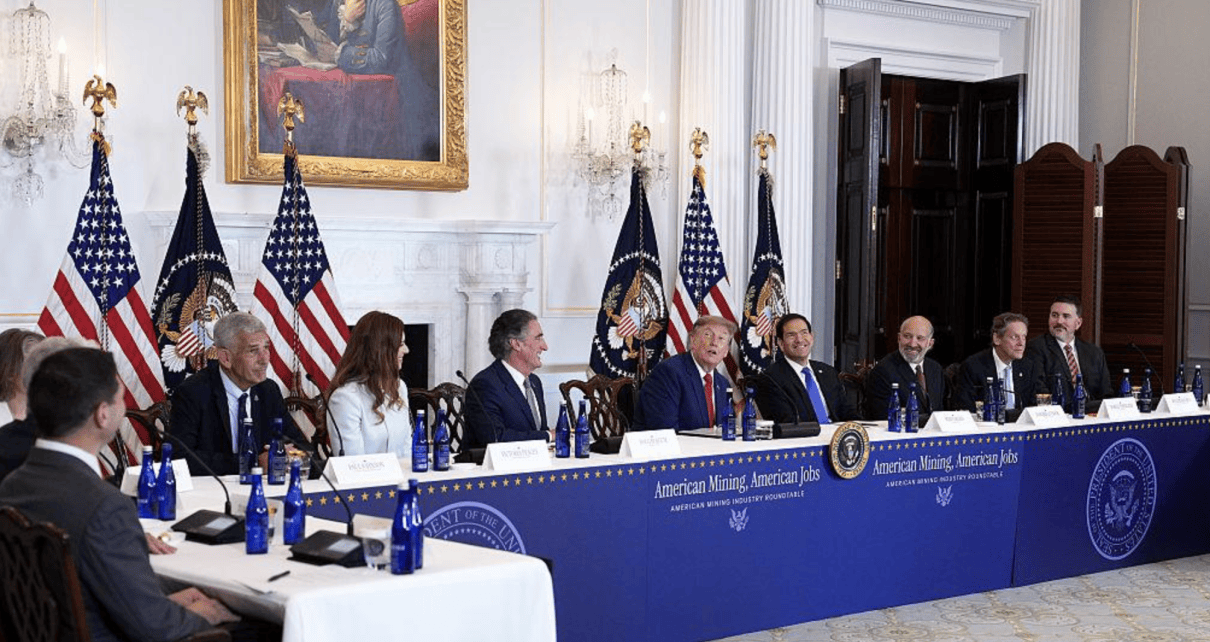
Trump unveiled the investments during a historic roundtable at the State Department attended by more than 200 mining executives, educators, investors and government officials—the largest presidential gathering with mining leaders in more than 120 years.
“We’re reclaiming America’s rightful place as the minerals superpower of the world,” Trump declared.
For Nevada, the announcement represents far more than another Washington spending package. The Silver State is already America’s mining capital, home to enormous gold, lithium and critical-mineral deposits, a sprawling network of mining businesses and one of the country’s premier mining schools.
The University of Nevada, Reno’s Mackay School of Mines is among 14 institutions positioned to benefit from a new $100 million federal workforce initiative included in Trump’s announcement.
UNR President Brian Sandoval attended Friday’s event as the administration rolled out the investments.
The package begins with the minerals required to build weapons, batteries, satellites, aircraft, electronics and nearly every piece of advanced American machinery.
According to the White House, the Department of War will invest $1.4 billion in California-based Sila Nanotechnologies to expand production of silicon-carbon battery anodes and construct a lithium-ion battery-cell manufacturing facility.
Those batteries will support satellite operations, unmanned aerial systems and munitions.
Another $400 million will help Sunrise Energy Metals develop a complete scandium supply chain, including what is expected to become the world’s first primary scandium mine. Scandium is used in lightweight, heat-resistant aluminum alloys needed for fighter jets and spacecraft.
The Department of War will invest $150 million in Minnesota-based Niron Magnetics, which is developing permanent magnets made entirely in the United States without rare earth elements.
That distinction matters because China has spent decades establishing dominance over the mining and processing of the rare earth materials used in conventional permanent magnets. Those magnets are essential components in missiles, aircraft, radar systems, vehicles, electronics and industrial machinery.
Trump’s investment offers a direct American answer: If China controls the mineral, build a magnet that does not need it.
The administration will also invest more than $85 million in Standard Bauxite to secure refractory-grade bauxite used in high-temperature materials and military components.
The Export-Import Bank is supporting additional graphite, boron, tantalum and niobium projects in Alabama, California and Pennsylvania. The Development Finance Corporation will also match a $4.8 million investment in a rare earth mine in Madagascar, securing another friendly supply of minerals needed by American manufacturers.
Not every project is physically located inside the United States. The broader strategy is to build domestic production wherever possible while securing dependable supplies from allied countries when necessary.
What Trump is rejecting is dependence upon hostile governments capable of shutting off the minerals America needs to manufacture weapons, vehicles, electronics and energy infrastructure.
The American economy may run on software, but the servers, batteries, power lines, satellites and weapons supporting it must still be built from something pulled from the ground.
For decades, Washington politicians acted as though the mining could be outsourced without surrendering the industries that depended upon it. The United States closed mines, surrendered processing capacity and buried projects beneath years of permitting while China built a mineral empire.
The result was cheaper imports followed by a much more expensive strategic vulnerability.
According to the Department of Energy, more than 95 percent of America’s rare earth supply comes from foreign sources. The country depends upon foreign sources for more than half of most critical minerals and relies entirely on imports for at least 14 of them.
Trump is attempting to reverse that surrender one mine, refinery, processing facility and engineering graduate at a time.
The workforce component may prove especially important for Nevada.
The Department of Energy’s new $100 million Providing Opportunities for Specialized Education in Critical Technologies initiative—mercifully shortened to PROSPECT—will support scholarships, financial assistance, new curricula and teaching programs across America’s 14 accredited mining schools.
The administration aims to double the number of graduates earning mining, mineral-processing and supply-chain credentials within two years.
The Department of Energy estimates that America will need approximately 6,000 additional mining engineers during the coming decade. That does not include the metallurgists, geologists, technicians, materials scientists and recycling specialists required to operate a complete mineral supply chain.
UNR’s Mackay School is included among the 14 schools expected to benefit from PROSPECT.
The school has trained Nevada miners, geologists and engineers for more than a century. Its graduates frequently enter an industry where demand is so strong that students can leave campus with multiple job offers.
The timing could hardly be better.
UNR is working toward the creation of a Great Basin Critical Minerals Resource Center by 2030. The proposed facility would combine academic research, workforce training and pilot-scale mineral processing, allowing students and companies to test new extraction and processing technology using Nevada resources.
The university is also helping build what state leaders call Nevada’s “Lithium Loop”—a roughly 200-mile network of lithium deposits, mines, battery manufacturers, recyclers, researchers and educational institutions.
“If you have the mine but not the workers, you have a hole in the ground,” Trump said during Friday’s roundtable. “If you have the workers but not the permits, you have a classroom full of people with no jobs.”
Trump’s approach is designed to address both ends of that equation.
The Department of War is separately investing more than $80 million in mining-education and technology programs at the Colorado School of Mines, South Dakota School of Mines and Johns Hopkins University. Those projects will create innovation hubs, connect students with defense manufacturers and train hundreds of students in mining, geology and metallurgy.
Some of the largest company investments announced Friday remain conditional upon negotiations and companies reaching required financial and technical milestones. Mines and processing facilities also take years to permit, finance and construct.
America did not surrender its mineral independence overnight, and it will not recover it with one roundtable.
But the direction has changed.
Since January 2025, the Trump administration has signed or approved 160 mineral deals totaling nearly $40 billion. Trump has used tariffs to protect American steel, aluminum and copper producers, streamlined permitting for mineral projects and directed the government to secure recoverable critical materials from industrial waste and used products.
His July executive orders also instructed the Department of War to secure the domestic materials needed to manufacture America’s most advanced battlefield equipment.
Nevada is uniquely positioned to capitalize.
According to Gov. Joe Lombardo’s 2026 Nevada Mineral Industry Week proclamation, mining directly employs more than 14,500 Nevadans and supports nearly 30,000 additional jobs. More than 2,500 businesses depend upon the industry.
Nevada produces more than 20 metals and minerals and accounts for approximately 11.3 percent of the value of all non-fuel mineral production in the United States.
The industry generated $12.6 billion in gross proceeds in 2024 and contributed nearly $190 million directly to Nevada’s General Education Fund. Nevada also produced 64 percent of America’s gold in 2025, continuing a four-decade run as the nation’s leading gold producer.
The next mining boom, however, will not be measured in gold alone.
Lithium powers batteries. Scandium strengthens aircraft. Rare earths guide missiles. Copper carries electricity. Boron strengthens glass and semiconductors. Graphite supports battery production. Tantalum and niobium are essential to electronics, magnets and steel.
The country controlling those materials controls the factories, weapons and technologies built from them.
China understood that decades ago. Washington is finally catching up.
Trump’s formula is uncomplicated: Mine here, process here, manufacture here and train American workers here. When domestic production cannot immediately meet demand, secure supplies from allies instead of begging adversaries.
Nevada helped build America with the gold and silver beneath its mountains. It can now help defend the country with the lithium, copper and critical minerals buried in the same soil.
Trump is placing billions of dollars behind that future—and ensuring the next generation of Nevada miners will be ready to dig it out.


- NWS Flood Watch Takes Effect Across Las Vegas Valley as Remnants of Tropical Storm Rachel Menace Mojave Basin - October 10, 2026
- “Operation Loaded Dice”: Federal and Local Task Forces Net 144 Arrests in Expansive Southern Nevada Gang and Narcotics Crackdown - October 10, 2026
- PAYDAY AT THE PUMP: Buck Unleashes $300K-Plus Ad Blitz Hammering Titus on Gas Taxes - October 10, 2026
RELATED ARTICLES
-
 January 25, 2023
 -
January 25, 2023
-
January 25, 2023