
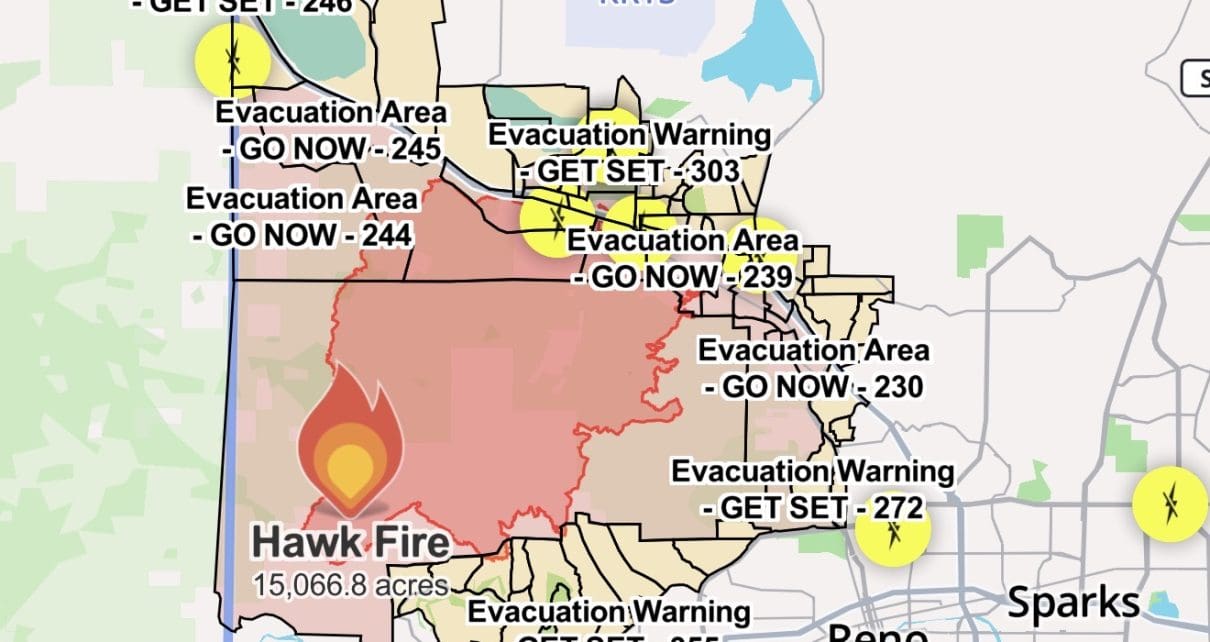
Source: Watch Duty | app.watchduty.org
They Could End the Hawk Fire ASAP with Cloud Seeding. What Are They Waiting For?
By TheNevadaGlobeStaff, August 25, 2026 2:24 pm
The Hawk Fire is ripping through northwest Reno and the North Valleys right now. Over 15,000 acres have burned since it ignited on August 22 near Peavine Peak. It sits at 27 percent contained in the latest updates. Dozens of homes are destroyed or damaged. Tens of thousands of Nevadans remain under evacuation orders or warnings. A small army of nearly 900 personnel, more than 80 engines, 10 helicopters, dozers, and crews keeps grinding away at a cost of millions. Governor Lombardo has declared a state of emergency. Families are displaced. Property is gone. Wildlife habitat is scorched. And the bill for this conventional response climbs by the hour.
There is a proven technology already operating in the Sierra Nevada and across Nevada that is designed to generate additional rainfall and snowfall. It is not a conspiracy theory. It is not “chemtrails.” It is publicly funded, put out to competitive bid, awarded through formal government and utility contracts, reported to state legislatures and federal agencies, and actively run by the Desert Research Institute and specialized companies. The question is simple: Why isn’t it being deployed right now to help knock down the Hawk Fire before more homes are lost and more people are put at risk?
This Is Real, Active, and Documented. Not Conspiracy
Cloud seeding has been conducted in the Sierra Nevada watersheds of California and Nevada for decades. In Nevada, the Desert Research Institute (DRI) operates the official Nevada State Cloud Seeding Program. Since 2023 the Nevada Legislature has appropriated roughly $600,000 a year to DRI for it. Generators release microscopic silver iodide particles into suitable winter storms so that more ice crystals form, more snow falls, and more water ends up in the snowpack and later runoff. Official DRI and legislative reports show results in the tens of thousands of acre-feet of additional snow water equivalent in recent seasons. That water is produced at a cost of roughly $10 to $15 per acre-foot. That is orders of magnitude cheaper than most other water sources.
The program targets the Tahoe-Truckee watershed (Sierra Crest west of Lake Tahoe, right in Washoe County’s backyard), the Ruby Mountains, Santa Rosa Mountains, and Spring Mountains. Ground-based generators do the work. Operations are public. Results are quantified and reported to the Legislature. DRI’s own website and program materials describe the science and the locations.
In California’s Sierra, utilities and irrigation districts have run parallel programs for generations: PG&E in the Mokelumne and Lake Almanor, SMUD in the Upper American River, and others in the Tuolumne, San Joaquin, Kings, and more. These are not secret. Sponsors file Notices of Intent with the California Department of Water Resources. They report to NOAA under federal weather-modification law. Independent statistical evaluations of multiple Sierra programs have found measurable increases in streamflow in several target watersheds.
The work goes out to bid. Water agencies and districts issue Requests for Proposals. Contracts are awarded. Examples include multi-year agreements between irrigation districts and Weather Modification LLC, competitive processes that selected North American Weather Consultants for operations and DRI for validation on Southern California pilots, formal cost-share deals between PG&E and East Bay MUD, and CEQA processes for expansions. Companies such as North American Weather Consultants, RHS Consulting, Weather Modification Inc., and others respond to these public solicitations and perform the work. Nevada’s own state funding of DRI is a matter of legislative record. This is ordinary government and utility contracting for a recognized water-resource tool.
Anyone claiming this is somehow hidden or theoretical is simply ignoring the public record: legislative PDFs, DRI reports, utility board packets, NOAA filings, and peer-reviewed evaluations of Sierra programs.
Historical Precedent: It Has Been Used Aggressively Before
Modern operational programs in the Sierra focus on enhancing precipitation from existing suitable clouds, particularly orographic winter storms that already contain supercooled liquid water. That is the standard description used by DRI and the California programs. But the technology has a longer and more aggressive history.
During the Vietnam War, the U.S. military ran Operation Popeye from 1967 to 1972, a classified cloud-seeding campaign over the Ho Chi Minh Trail. Aircraft dispersed silver iodide and other agents with the explicit goal of extending the monsoon season, increasing rainfall, softening roads, triggering landslides, and washing out crossings to interdict enemy logistics. Participants, including researcher and pilot Ben Livingston, have described missions that produced heavy localized rain and tangible disruption. The program was real, it was sustained over years, and it was later declassified. It demonstrated that weather modification could be scaled and directed for tactical effect when the political and operational will existed.
If the technology could be used decades ago to try to flood a jungle supply route, the claim that it can only ever produce modest incremental snow in winter becomes harder to treat as an absolute limit. Atmospheric conditions matter. Suitable clouds matter. But the capability exists, the operators exist, the equipment exists, and the public contracting pathways already exist.
Cost Comparison: Seeding vs. the Current Response
The Hawk Fire is already consuming enormous resources: hundreds of firefighters, dozens of engines, multiple helicopters, dozers, incident management teams, and the associated logistics, overtime, and aircraft fuel. Large wildfires of this scale routinely run into the millions of dollars per day. Cloud seeding programs in Nevada and California operate at a tiny fraction of that cost. Nevada’s entire annual state cloud-seeding budget is in the low hundreds of thousands. Individual operational seasons or targeted campaigns are far cheaper than sustaining a multi-day aerial and ground assault with nearly a thousand personnel.
If seeding can deliver even a meaningful pulse of rain over the fire area or the surrounding fuels, the return on that modest investment (reduced suppression costs, fewer structures lost, fewer evacuations prolonged, and less damage to watersheds and wildlife) would be dramatic. Waiting while conventional resources grind away is the expensive choice.
What Are They Waiting For?
The Hawk Fire is burning in Washoe County, in the same region where DRI already runs generators for the Tahoe-Truckee program. The operators, the technology, the institutional knowledge, and the contracting mechanisms are already in place for winter operations. Extending or adapting that capability for an emergency summer application is not science fiction. It is a policy and operational decision.
Every day of delay means more risk to homes, more strain on first responders, more smoke impacting public health, and more irreversible damage. Residents should not have to accept that the only tools on the table are the ones already being used at enormous cost.
Call Your Representatives. Tell Them to Act
Demand that officials explore immediate deployment of cloud seeding or other precipitation-enhancement options on the Hawk Fire and future wildfires. Contact them directly:
Governor Joe Lombardo
Northern Nevada office: (775) 684-5670
State Capitol Building, 101 N. Carson Street, Carson City, NV 89701
Southern Nevada: (702) 486-2500
U.S. Senators
Senator Catherine Cortez Masto: (202) 224-3542 (Washington); Reno office available via cortezmasto.senate.gov
Senator Jacky Rosen: (202) 224-6244 (Washington); Reno office available via rosen.senate.gov
U.S. House (Northern Nevada / NV-02)
Congressman Mark Amodei: (775) 686-5760 (Reno office); (202) 225-6155 (Washington)
Washoe County Board of County Commissioners
Clara Andriola (Chair, District 4): (775) 444-5185
Mariluz Garcia (Vice Chair, District 3): (775) 444-0628
Alexis Hill (District 1): (775) 447-3017
Michael Clark (District 2): (775) 686-0342
Jeanne Herman (District 5): (775) 358-0555
Also contact your Nevada State Senator and Assemblymember. Find your representatives by address through the Nevada Legislature at leg.state.nv.us. Key Washoe-area legislators include members representing Districts 13–16 in the Senate and multiple Assembly districts covering Reno and the North Valleys. Call the Legislative Counsel Bureau or use the “Find My Legislator” tool.
Ask them three simple things:
- Has anyone formally evaluated deploying cloud seeding or precipitation enhancement against the Hawk Fire?
- Why is a technology the state already funds for water supply not being considered as an emergency tool?
- What is the cost-benefit comparison between continued conventional suppression and a targeted seeding effort?
This is not fringe. Cloud seeding is funded by the Nevada Legislature, operated by DRI, contracted through public processes in California and elsewhere, reported to federal agencies, and has historical military application. The Hawk Fire is burning in the backyard of existing programs. The resources are already being spent at massive scale. The technology to try something additional sits on the shelf.
What are they waiting for?
Speak Up, Nevada! What’s on Your Mind? Send us your opinion!
Got the inside scoop on something happening in Nevada? Or the country? Do you have thoughts about life in Nevada that are too good to keep to yourself? Whether it’s a hot take on our politics, crime, education, or even the secret to surviving our summers, we’re all ears! Swing them our way at editor@thenevadaglobe.com. Come on, give us the scoop on what makes Nevada tick—or what ticks you off. Let’s make some noise and have some fun with it!


- MADE IN AMERICA MOMENT: Trump Touts Coast-to-Coast Industrial Investment Surge - October 27, 2026
- Newark-Bound United Flight Returns to Las Vegas After Passenger Makes Alleged Terror Threat Mid-Flight - October 26, 2026
- Nevada Sex Offender on the Run Since 2022 Extradited to Clark County Jail Following Mississippi Arrest - October 26, 2026
RELATED ARTICLES
-

-
August 22, 2022
-