
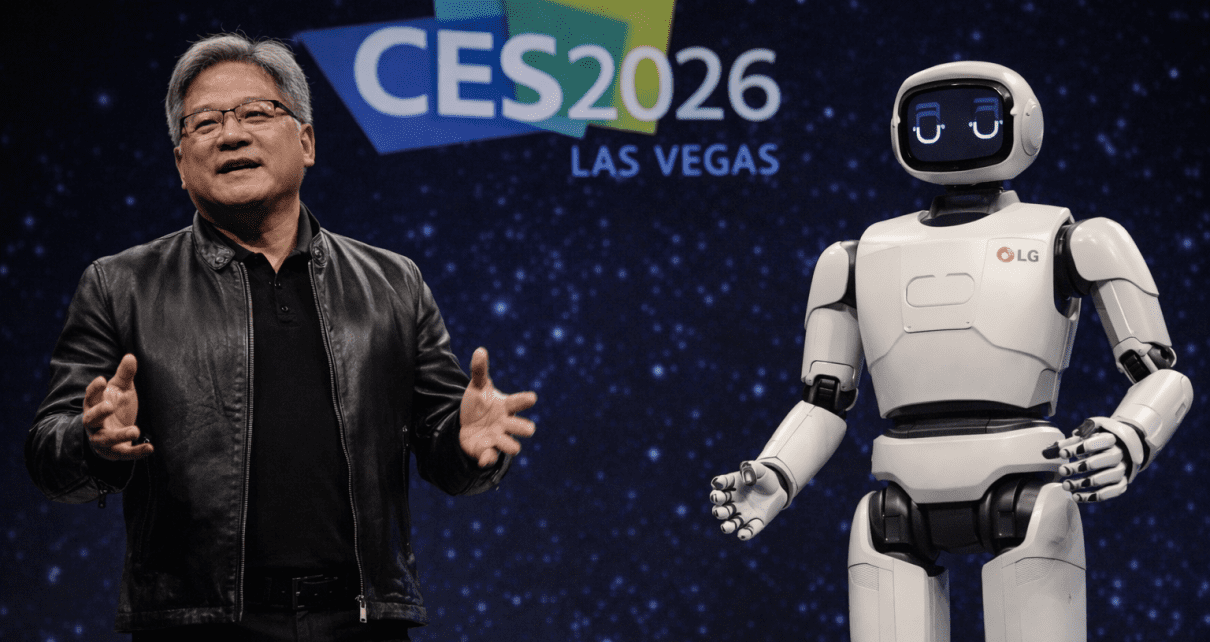
CES 2026 Highlights Nvidia AI Advances and LG Robotics Prototype
By TheNevadaGlobeStaff, January 5, 2026 3:30 pm
Nvidia unveiled its next-generation Vera Rubin superchip during CES 2026 in Las Vegas, marking a major update to the company’s AI computing roadmap. The new processor is part of Nvidia’s broader Rubin platform and integrates one Vera CPU with two Rubin GPUs into a single chip designed for advanced artificial intelligence workloads.
According to Nvidia, the Rubin platform is built to support emerging AI use cases such as agent-based systems, advanced reasoning models, and mixture-of-experts architectures. These models rely on routing tasks across specialized AI systems to improve efficiency and performance.
Nvidia CEO Jensen Huang said the Rubin platform arrives at a time when demand for AI computing power continues to rise rapidly. He noted that the company’s annual release cycle and coordinated chip design aim to push AI infrastructure into its next phase.
Beyond the core processor, the Rubin platform includes additional networking and data management components, such as NVLink 6 Switches, ConnectX-9 SuperNICs, BlueField-4 DPUs, and Spectrum-6 Ethernet switches. These elements can be combined into Nvidia’s Vera Rubin NVL72 server, which links 72 GPUs into a single system. Multiple NVL72 servers can then be connected to form Nvidia’s DGX SuperPOD, a large-scale AI supercomputing system used by major technology companies.
Nvidia also introduced its Inference Context Memory Storage technology, which is intended to support large-scale AI models that require extensive data storage and sharing across systems.
The company stated that the Rubin platform offers significant efficiency improvements over its previous Grace Blackwell architecture. Nvidia claims the new system can reduce the number of GPUs required for training certain AI models while also lowering inference costs by reducing the computational expense of processing AI tokens.
Separately at CES, LG showcased a humanoid robot prototype called CLOiD. The robot demonstrated basic household tasks such as handling laundry items and interacting with appliances. LG representatives said the robot remains in the prototype stage and requires further development before potential consumer release.
While the CLOiD demonstration highlighted advances in robotics design and mobility, LG has not provided a timeline or pricing details for a commercial version. Similar household robotics concepts have appeared at CES in past years, though few have reached widespread consumer availability.
CES 2026 featured a range of announcements highlighting rapid advancements in artificial intelligence, robotics, and computing infrastructure, with companies emphasizing both future potential and current technical limitations.
Source: Original reporting from CES 2026 coverage.
Copyright 2025 702 Times, NV Globe. All rights reserved.


- TRUMP, XI STRIKE $30 BILLION TARIFF DEAL AS CHINA AGREES TO BUY U.S. COAL - September 26, 2026
- Two Critically Injured in High-Impact Collision Near Bonanza Road; Metro Collision Detail Investigates - September 26, 2026
- Metro Police Release Video of Gunman on E-Bike Fleeing Ambush of Off-Duty Corrections Officer - September 25, 2026
RELATED ARTICLES
-
 December 12, 2024
 -
-
September 15, 2025